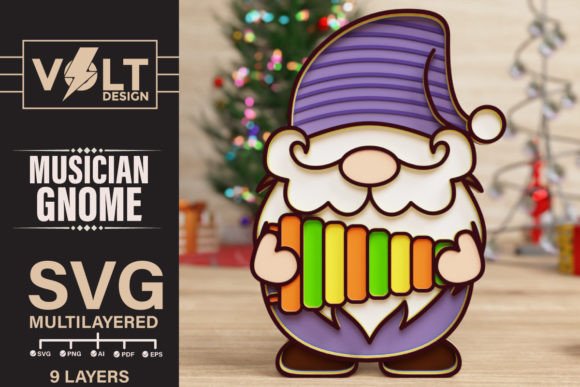
Reviewing the Musician Gnome 3D SVG for Embroidery
As a designer who spends half my life digitizing and the other half stitching, I have learned to look past the flashy preview images. When I first opened the Musician Gnome 3D SVG Multilayered Cut, my immediate reaction was not just about the cut lines, but about how this specific aesthetic translates into thread. We often see digital files that look perfect on a screen but fail miserably under the needle. However, this design presents an interesting case study for those of us bridging the gap between paper crafting and machine embroidery.
The mood here is whimsical yet structured. The gnome motif, a staple in modern home decor, gets a fresh twist with the musician element. It feels cozy, festive, and inherently Christmas-adjacent without being overly traditional. For an embroidery project, this visual personality suggests warmth. It is not just a graphic; it is a character. When I imagine this stitched out, I am thinking about texture. The "3D" aspect in the SVG world usually implies layering for shadow boxes, but in embroidery, we achieve depth through stitch types and thread sheen. The challenge—and the opportunity—lies in interpreting these layers into satin stitches, fill stitches, and running stitches that hold up on fabric.
Real-World Application: The Holiday Tote Test
To truly evaluate a design, you must place it in context. I recently worked on a batch of custom canvas tote bags for a local boutique’s holiday release. The client wanted something that felt handmade but polished. I considered using the Musician Gnome 3D SVG Multilayered Cut as the basis for an embroidered patch or direct-to-garment design. Here is where the practical judgment comes in.
If you are an Etsy seller or a small shop owner, you know that customers buy with their eyes but judge with their hands. A sweatshirt embroidery piece needs to feel soft, not like a cardboard sticker. If I were adapting this multilayered concept for a sweatshirt embroidery project, I would simplify the inner details. The SVG provides complex layers, but on a textured fleece, too many tiny satin columns can get lost. Instead, I would use the outer shapes for bold fill stitches and reserve the finer musical notes for high-contrast thread colors. This ensures the design remains legible from a distance, which is crucial for apparel.
For a tote bag design, the stakes are different. Canvas is sturdy, allowing for higher stitch density without puckering. Here, the gnome’s hat and beard could utilize dense fill stitches to create a plush, tactile experience. The musician element—perhaps a guitar or violin depending on the specific variant in the file—would pop beautifully against the neutral background. This transforms a simple bag into a personalized gift that feels substantial and valuable.
Navigating Fabric and Hoop Constraints
One must be realistic about where this design fits. While the 3D SVG format offers versatility for cutting machines, embroidery has physical limits. If you are planning to stitch this on a cap or a curved surface, proceed with caution. Curved fabrics distort designs. The wide stance of a gnome figure might require breaking the design into smaller sections or using a specialized cap frame to maintain alignment.
Similarly, consider the hoop size. If your machine only accommodates a 4x4 inch hoop, you may need to resize the Musician Gnome 3D SVG Multilayered Cut significantly. Shrinking a detailed design too much results in merged stitches and lost definition. Always check the dimensions provided in the included PDF or AI file before committing to a purchase or project. If the design is intended for wall art or larger home decor, it likely requires a 5x7 or larger hoop to breathe properly.
Fabric texture also plays a pivotal role. On thin or stretchy fabrics, such as those used for baby embroidery items, the weight of the thread can cause sagging. In these cases, a heavy-cut stabilizer is non-negotiable. I would advise testing the design on scrap fabric first. Check how the thread colors interact with the material. A dark gnome beard on a black shirt will vanish unless you use metallic or high-sheen rayon threads to create separation through light reflection rather than just color contrast.
Commercial Viability and Brand Consistency
For commercial embroidery professionals, consistency is key. You cannot afford a design that stitches out differently every time. The fact that this product includes AI, EPS, SVG, PNG, and PDF files is a significant advantage. It means you have vector scalability. You can inspect the paths in Illustrator or CorelDRAW before digitizing or sending to your embroidery software. This level of control allows you to clean up nodes and ensure smooth curves, which directly impacts the quality of the finished product.
When selling handmade products, perceived value drives price. A well-executed gnome design on a kitchen towel or pillow cover can command a higher price point if the stitching is crisp. The "musician" theme adds a niche appeal, targeting music lovers or teachers, which expands your customer base beyond general holiday shoppers. This specificity helps in creating targeted printable mockups and social media content that resonates with specific buyer personas.
However, always verify the license. The description states you can sell the physical project. This is vital for craft business owners. Ensure you understand the boundaries. Can you sell the digitized embroidery file itself? Usually, no. But selling the stitched apron or the embroidered patch is typically permitted. Clarity here protects your Etsy seller account and builds trust with your customers.
Practical Designer Notes for Execution
Before you load this onto your machine, take a moment to plan. Here is my checklist for ensuring success with the Musician Gnome 3D SVG Multilayered Cut:
- Test on Scraps: Never run a new design on your final garment. Use similar fabric and stabilizer combinations to test tension and density.
- Contrast Check: View the design in black and white. If the details disappear, you need to adjust thread choices or simplify the stitch pattern.
- Stabilizer Selection: Match the stabilizer to the fabric. Cut-away for knits and stretchy materials; tear-away for stable wovens like cotton or linen.
- Thread Quality: Use high-quality rayon or polyester threads. Cheap thread breaks and frays, ruining the professional look of the embroidered patch or apparel.
- Detail Inspection: Zoom in on the SVG file. Are there tiny elements that might not stitch well? Consider removing or enlarging them in your digitizing software.
In conclusion, the Musician Gnome 3D SVG Multilayered Cut is a versatile asset for the creative entrepreneur. It bridges the gap between digital crafting and textile art. Whether you are creating holiday embroidery for gifts or stocking your small shop product line, this design offers a charming, festive aesthetic. By respecting the technical constraints of embroidery and leveraging the flexibility of the provided file formats, you can produce high-quality, engaging pieces that customers will love. Remember, the best design is not just the one that looks good on screen, but the one that stitches out cleanly, wears well, and brings joy to the recipient.